
Tea with Linda - Moderation
Tea with Linda - Moderation
Contributor: Linda Kavelin Popov, Co-Founder of TVP, March 2025
I recently rediscovered that orderliness is a companion virtue to moderation. I have a client who is a self-proclaimed hoarder and is severely challenged to maintain order. Multiple disabilities don’t prevent her from having heaps of creativity with things that interest her. She’s a brilliant poet soon to publish her first book. However, she feels blocked from simple things like sorting clean and dirty clothes, which land on the floor in a jumble. She is forever losing things because nothing has its own place other than haphazardly stuffed in a box or under her bed. Her mother has regular meltdowns about the state of her room.
Now in her twenties, she is determined to live a normal independent life…soon. So, we are tackling basic life skills and the virtues that support them, like tidying her room, transforming chaos into a tranquility zone.
While helping her, I realized that I’d been procrastinating creating order on my desk for months. The piles and mess of miscellany were cringe-worthy and the sheer magnitude of the job was hardly motivating. The more I put it off, the heavier the task became. So, she and I made a work agreement. Using a radical practice of moderation, we committed to apply the Japanese philosophy of Kai Zen, which is about making consistent incremental changes that are so small, they bypass the pressure of overwhelm. We wrote up the agreement and signed it. We agreed to do only ten minutes each day. Truly moderate! It worked fantastically -- for me.
I was amazed that it only took four ten-minute periods of focused attention to create a miracle of clarity and order on my desk. My friend’s victory was that her clothes were now sorted.
Next, she will tackle the books and papers stuffed under her bed. I intend to do a daily three-minute tidy to maintain the new beauty and grace of my workspace.
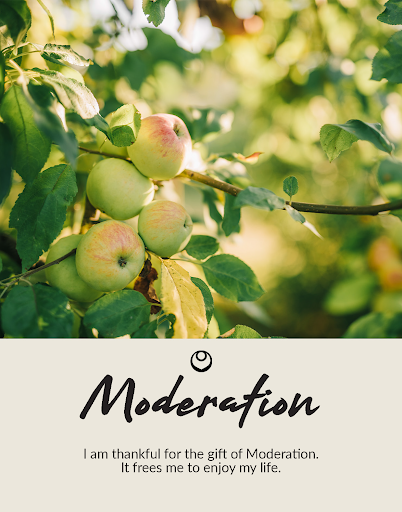
Back to moderation. I believe there is a longing for balance in our souls – a true pace of grace in work, reflection, rest, and play. One approach is to chunk our time, creating daily (very moderate) routines punctuated with occasional special adventures. If one has worked in a very focused and diligent way for a long period, a pause for applause can look like taking time for dinner with a friend, an adventure somewhere beautiful, or a weekend of holy puttering.
A friend who recently retired spoke of seeking balance between being of service and being slothful. How delightful to give oneself permission to do nothing. Automatically submitting to our lifetime script not to be “selfish” locks us into the FOG syndrome of fatigue, overwhelm and guilt.
I recently interviewed a nurse at our island hospital about her wellbeing. She admitted she has always put everyone else’s needs before her own. I asked her, “Do you love yourself enough to be as kind to you as you are to everyone else?” In that moment, I asked myself the same question. What is your answer?